
Ultra-Low Vibration Cryogenic Temperature Control System Multi-Photon Entanglement Source System Window Aberration Correction Objective Lens & Window Aberration Correction UV Objective Lens Closed-Loop Motorized Wave Plate Mount Fiber FP Cavity Tunable Filter High-Precision Temperature Control System for Micro-Environment

 Date:2026/2/3
 Source:Unitary Quantum
As 2026 unfolds, Unitary Quantum announces that it has become the first domestic enterprise to publicly achieve a Quantum Volume (QV) of 32.
Leveraging its self-developed trapped-ion quantum computing hardware and the inherent full connectivity advantage of the architecture, the R&D team has fully unlocked the potential of quantum bits and demonstrated system-level quantum computing power. This milestone not only verifies the superiority of the trapped-ion architecture in executing deep quantum circuits, but also highlights Unitary Quantum’s robust capabilities in developing high-performance full-stack quantum computers, marking a prominent new achievement for China’s quantum computing sector.
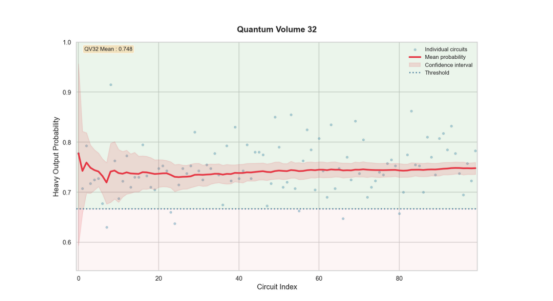
Unitary Quantum’s QV32 test results. The measured fidelity of random circuit outputs reaches 0.748, significantly exceeding the threshold of 0.667.
(Note: As the only quantum computing enterprise among the first batch of technology transfer recipients from the University of Science and Technology of China (USTC), Unitary Quantum is committed to the R&D and industrialization of trapped-ion quantum computing technology. The technical research and data analysis for this QV32 breakthrough were completed jointly by Unitary Quantum and the Quantum Information Laboratory of USTC.)
Recently, Unitary Quantum successfully achieved a QV of 32 on its self-developed high-transmission blade-type trapped-ion quantum computing system. The system precisely traps and manipulates an ion chain consisting of seven ytterbium-171 ions via electromagnetic fields. The middle five ions serve as core quantum bits under precise control, enabling the successful execution of 100 benchmark circuits for QV32 testing.
Per IBM’s definition, a quantum computer achieves a Quantum Volume of QV=2^N if it runs an N-layer square quantum circuit on N quantum bits. Each layer comprises a set of random single-qubit and two-qubit gates, and the overall circuit success probability must surpass 2/3 (approximately 0.667) with high confidence. Measured data shows the success rate of Unitary Quantum’s 5-qubit system in QV32 testing hits 0.748, consistently staying well above the threshold within the confidence interval. This proves the system can stably and reliably run complex quantum circuits corresponding to QV32, representing new progress in comprehensive performance metrics including qubit count, gate fidelity, connectivity and circuit execution capability.
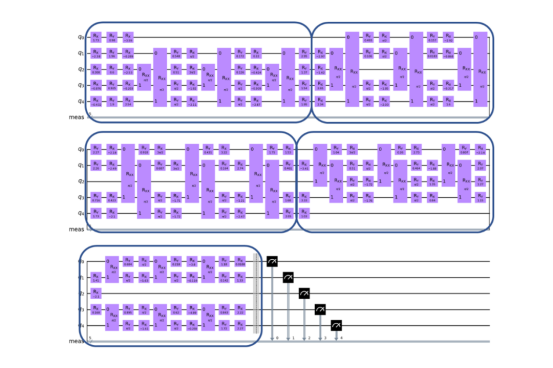
Unitary Quantum is thereby the first domestic quantum enterprise to publicly reach this key benchmark, with its full-stack quantum computing hardware performance entering the world’s advanced ranks. The figure below illustrates one random quantum circuit used in the QV32 test, containing 135 random single-qubit gates and 30 random two-qubit gates.
For a long time, public attention has tended to focus merely on the number of quantum bits. However, quantum computing requires not only scaling up qubit quantity but also boosting qubit quality to build viable full-stack quantum computers. Quantum computing power follows the barrel effect: poor connectivity, excessive noise or low gate fidelity will trigger rapid decoherence during complex computations regardless of qubit quantity, yielding invalid results. Quantum Volume is widely recognized across the industry as one of the most rigorous and scientific metrics to evaluate the overall performance of quantum computers.
A vital performance benchmark for the NISQ era, Quantum Volume is jointly determined by qubit quantity and maximum executable circuit depth. It demands both an adequate number of qubits and the capacity to run quantum circuits with high fidelity. QV32 = 2^5 means operators can freely compile and execute quantum circuits with hundreds of single-qubit gates and more than 30 two-qubit gates on stable physical hardware. The system supports arbitrary single-qubit gates with 99.9% fidelity and arbitrary two-qubit gates with 98.5% fidelity, delivering accurate and dependable computational outcomes.
As the first domestic company to publicly attain QV32, Unitary Quantum’s trapped-ion technical route delivers a unique advantage of native full connectivity.
Thanks to this feature, trapped-ion systems can deliver equivalent computing power with fewer qubits. At present, Unitary Quantum has realized full connectivity control over 12 qubits, maximizing hardware resource utilization. While there remains a gap in absolute qubit quantity compared with leading international superconducting quantum computing players such as IBM and Google, Unitary Quantum has fully capitalized on the strengths of the trapped-ion route in the core dimension of qubit quality. Every qubit boasts exceptional fidelity and full connectivity, allowing execution of deeper, more complex algorithmic tasks at the same hardware scale.
On the hardware front, Unitary Quantum has built robust scalability. The current vacuum system and trap design can stably trap more than 200 ions. With upgraded control systems and optimized optical path design, these trapped ions will gradually be converted into fully connected computing qubits.
On the algorithm front, Unitary Quantum has developed a suite of algorithms. In chemistry, the platform will substantially improve the performance of the Variational Quantum Eigensolver (VQE) to simulate the ground-state energy of small molecules with higher precision, generating more accurate models for new material development and drug design. In areas including financial portfolio optimization and logistics route planning, it will enhance the performance of the Quantum Approximate Optimization Algorithm (QAOA), demonstrating potential to outperform classical algorithms.
Unitary Quantum has opened its cloud platform featuring a 12-qubit fully connected trapped-ion quantum computer, providing physical hardware access for researchers across diverse disciplines.
The achievement of QV32 marks both a milestone and a new starting line for Unitary Quantum. We must remain sober-minded that objective gaps persist between China’s quantum computing industry and the world’s top tier. Quantinuum, a leading global trapped-ion quantum computing firm in the United States, launched its next-generation quantum computer Helios at the end of last year. Equipped with 98 high-fidelity qubits and pioneering energy efficiency, Helios stands as the world’s most powerful quantum device across all technical routes.
Unitary Quantum has been established for just over three years, yet its technical foundation originates from more than a decade of research by the research team led by Academician Guo Guangcan at the Key Laboratory of Quantum Information, Chinese Academy of Sciences. The team made the forward-looking decision to pursue the QCCD (Quantum Charge-Coupled Device) architecture, a technical path aligned with leading international trapped-ion players including Quantinuum and IonQ.
As an ancient Chinese saying goes, “The road ahead is long; I see no ending, yet high and low I’ll search with my will unbending.” Unitary Quantum has embarked on a challenging yet correct path: prioritizing high quality and steadily expanding the count of fully connected qubits. Realizing QV32 signifies that our quantum computers have moved beyond simple principle demonstration and gained the capability to run complex quantum circuits with practical value. Going forward, Unitary Quantum will continue to deepen research into trapped-ion technology. With higher-fidelity quantum computing power, we will empower the industrial application of China’s quantum technology and carve a solid Chinese footprint on the global map of quantum computing.
(English translation provided by AI)
Empowering Computing with Unity, Creating the Future with Quantum Technology
Email: business@unitqc.com
Tel: 15391985489
Address: 1-2/F, Building B1, Zhong'an Chuanggu Science and Technology Park Phase I, No. 900 Wangjiang West Road, High tech Zone, Hefei City, Anhui Province
 WeChat Official Account

