
Ultra-Low Vibration Cryogenic Temperature Control System Multi-Photon Entanglement Source System Window Aberration Correction Objective Lens & Window Aberration Correction UV Objective Lens Closed-Loop Motorized Wave Plate Mount Fiber FP Cavity Tunable Filter High-Precision Temperature Control System for Micro-Environment

 Date:2026/7/9
 Source:Ant Group Investment
Hosted by Zixin, each episode brings together one investor and one entrepreneur for in-depth dialogues that unpack cutting-edge practices and insights within China's tech industry.
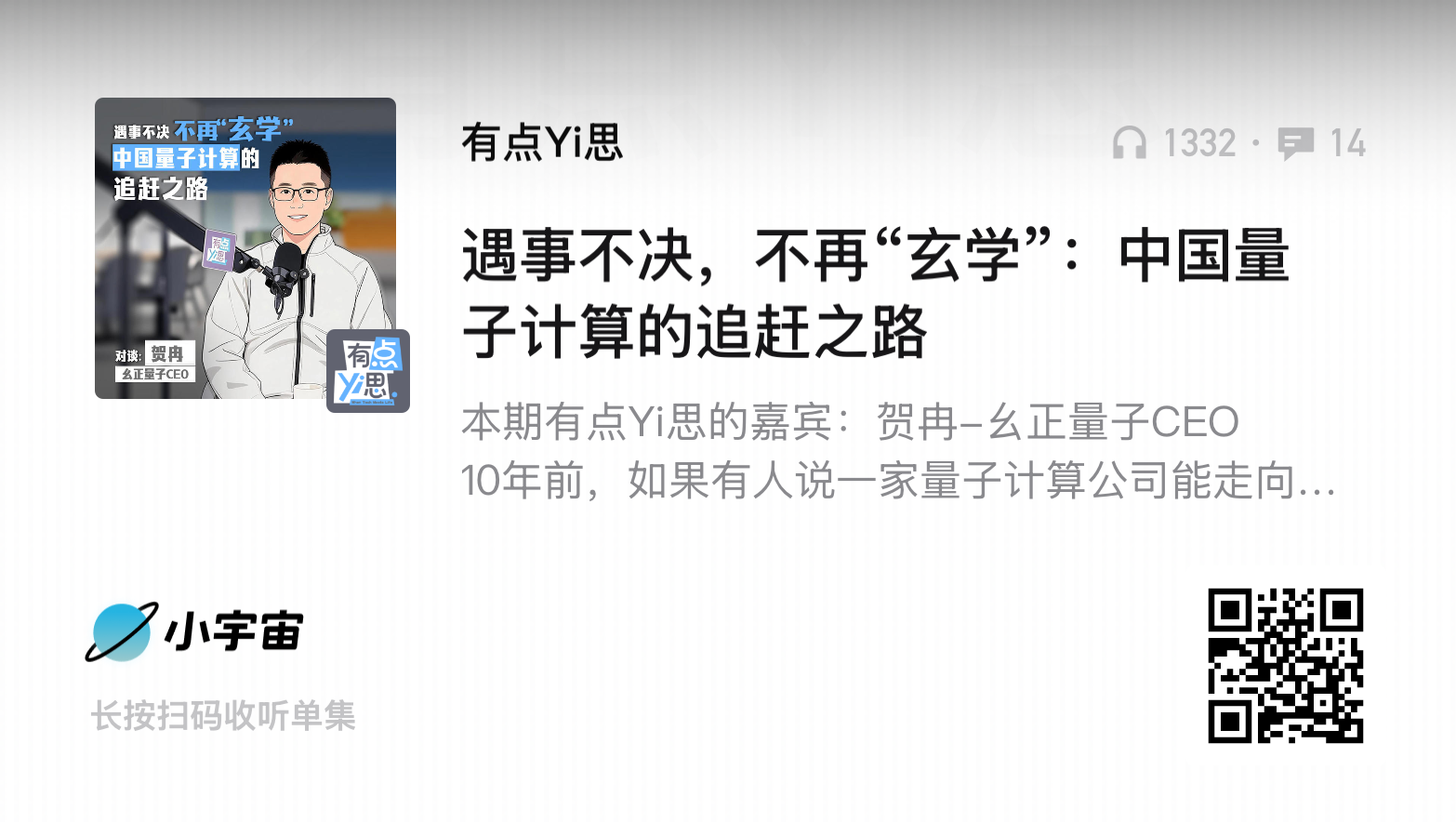
In the latest episode, He Ran, General Manager of Unitary Quantum, joins Yin Hang, Investor at Ant Group Investment, and host Zixin for an extensive discussion on quantum technology, an industry of the future. They explore how China's quantum computing sector is turning the "impossible" into reality as it transitions from laboratory research to full-scale engineering implementation.
Source: Ant Group Investment Official WeChat Account
For a long time, quantum computing was dismissed as a field that was "too far ahead of its time".
It remained largely a futuristic technology confined to labs: quantum phenomena could be verified, yet stable operation proved elusive; quantum properties could be demonstrated, but functional, usable computing systems were still far out of reach.
Then in 2019, Google ran an experiment on its quantum processor that completed calculations requiring tens of thousands of years on classical supercomputers in just 200 seconds. The hype around "quantum supremacy"swept the globe, yet the fervor faded quickly. People realized that lab-based quantum computers were still incapable of solving real-world practical problems.
Genuine transformation has unfolded over the past few years. On one hand, AI has sparked a global crisis of computing power scarcity, repositioning quantum computing as a leading candidate for the next generation of computing paradigms. On the other hand, the quantum industry itself has hit an engineering inflection point. Quantum startups have marched toward IPOs, tech giants have ramped up investment, fundraising in the primary market has surged, and tangible commercial orders and application explorations have emerged across the industrial landscape.
The industry’s core focus has also shifted from "can we generate quantum phenomena?" to "can we fully engineer practical quantum computing systems?"
Among all technical routes, trapped-ion quantum computing has garnered immense attention. Compared with superconducting and neutral-atom platforms, trapped ions deliver unmatched control precision and far better stability, critical benchmarks for universal quantum computing. While single-qubit and two-qubit gate operations were validated early on, the technology long struggled with scalability bottlenecks.
This all changed with the maturation of the QCCD (Quantum Charge-Coupled Device) architecture. At its core, QCCD enables controlled ion transport and segmented parallel collaboration across a chip surface, analogous to an orderly urban traffic network. For the first time, trapped-ion systems reconcile high precision with scalable expansion, delivering tangible engineering viability to the industry. After 2022, trapped-ion development accelerated sharply, with qubit counts nearly doubling year over year.
Chinese teams have also stepped into this global engineering race. In 2022, several professors from the University of Science and Technology of China, alongside PhD graduate He Ran, founded Unitary Quantum in Hefei. Their core conviction: viable quantum computers cannot be built solely within academic labs—they demand corporate organizational structures, specialized engineering divisions, and cross-industry supply chain collaboration. Over three years, the firm has grown from a handful of staff to nearly 90 employees, including 60–70 engineers and close to 20 PhD holders. While a university lab may spend one to two years iterating a full system, Unitary has compressed its iteration cycle to once per month.
In 2024, Unitary Quantum delivered its first full trapped-ion quantum computer system. In early 2026, the company announced it had completed Quantum Volume 32 (QV32) benchmark testing, setting a new publicly reported domestic record and elevating its full-system performance to an internationally advanced tier.
China's quantum computing sector has moved past the question of "can we build quantum hardware?"and entered a new era defined by "can we deliver fully engineered, functional quantum systems?"
In this conversation, they dive into these key topics:
How a childhood dream of becoming a scientist evolved from skepticism toward quantum mechanics to harnessing quantum physics to reshape the world;
How Chinese trapped-ion teams are closing the gap with Western counterparts, which launched research seven to eight years earlier, through ultra-fast iterative development;
A plain-language breakdown of the QCCD architecture;
With fewer than 50 new quantum computing graduates entering the workforce annually in China, how mentorship programs train non-specialized engineers into elite technical talent within six months;
What quantum advantage truly signifies, and why quantum computing is an inevitable technology dictated by fundamental physics;
The core distinctions between quantum and classical computers;
How entrepreneurs balance the powerful growth momentum alongside market bubbles amid the current capital frenzy for hard tech.
Scan the QR code to listen to this episode:
HIGHLIGHTS
When I first studied quantum mechanics, I thought the theory was just speculative guesswork'only after trapping ions with my own hands did I truly grasp its physical reality.
Over six years, I assembled six to seven full trapped-ion systems from scratch; it was like building rockets by hand. I endured repeated failures, including a six-month stretch with zero technical progress at my lowest point.
A one-year research exchange at ETH Zurich revealed that overseas researchers were not inherently more intelligent—they simply had a multi-year head start. This insight strengthened my resolve to catch up and surpass them.
The company was founded by five professor co-founders plus one student, with no external seed funding in the early days; the professors personally invested to rent laboratory premises.
Our systems undergo 12 full iterations per year at the company; projects that take university labs one to two years to complete are finished within a month here.
Only around 50 new quantum computing talents graduate in China each year, so we rely on hands-on mentorship to cultivate in-house engineering teams.
QCCD architecture enables ions to "flow"across functional zones like assembly line workers.
We completed QV32 benchmark testing, setting a new publicly disclosed national performance record.
Zixin: You studied physics at Dalian University of Technology for your undergraduate degree. What drew you to this major back then?
He Ran: I’ve loved physics since high school. As a kid, my reading material was limited, but I devoured biographies of Einstein and Newton, and always dreamed of pursuing physics research. I still remember setting a QQ profile signature back in middle school that I’ve never changed: “I aim to become a great scientist.”
Zixin: Why were you less enthusiastic about quantum mechanics during undergrad?
He Ran: It lost its appeal because it was tied to exams and problem sets—no one enjoys constant testing. Electrodynamics, by contrast, lets you derive Maxwell’s equations from first principles on a blank sheet of paper from start to finish. Quantum mechanics, however, begins with numerous unproven postulates; the Schr?dinger equation was essentially hypothesized, unlike Newton’s laws, which stem logically from three core axioms. I thought the framework felt incomplete, so I lacked enthusiasm for it at the time.
Zixin: Did your perspective shift later on?
He Ran: Even during my PhD studies, I still questioned whether quantum mechanics reflected true physical reality, echoing the historic debates between Einstein and Bohr a century ago. But I designed and ran countless intricate experiments, and the raw data confirmed quantum mechanics as an accurate description of nature. It is not merely a framework to explain the universe—it lets us manipulate the tiniest particles to reshape it. Witnessing abstract equations transform into tangible, controllable quantum systems completely changed my outlook.
Zixin: What was your most formative experience during postgraduate research?
He Ran: My graduate years were grueling. When I joined the lab, trapped-ion research in China had only been underway for two to three years, so our technical foundation was relatively weak. We had a running joke back then: “Never forget the trappers who dug the ion trap”—and I was the one building those traps from the ground up.
Constructing a high-performance ion trap is an extraordinarily labor-intensive, finicky process. Over my six PhD years, I built six or seven complete trapped-ion setups. In 2016, my ultra-high vacuum system failed six times in a row for unrelated reasons: uneven heating, hardware malfunctions, unplanned power outages. I wasted six full months without any meaningful progress. Our lab facilities were spartan, and power cuts were frequent due to nearby subway construction that repeatedly damaged power cables.
Zixin: Can you draw a simple analogy to explain what building an ion trap entails?
He Ran: It’s akin to hand-building a rocket, and I’ve built several from scratch. The workflow starts with 3D modeling on a computer, sourcing vacuum components, and manually fabricating electrodes—imagine four parallel toothpicks that must align with positioning precision of roughly 10 micrometers, with flawlessly smooth surfaces. Once assembled, the electrode assembly is carefully sealed inside a vacuum chamber with airtight flanges, then baked at 200–300°C for two weeks to eliminate residual gas. If the power cuts out, or a lab mate accidentally unplugs the equipment, those two weeks of work are wasted entirely.
Yin Hang: Anyone who has run hands-on physics experiments understands that errors emerge constantly from unforeseen sources. It’s like a snail climbing a well: two steps forward by day, one slip backward overnight. When aligning an optical table, a screw over-tightened by a fraction of a turn will throw off the entire optical path once temperatures shift overnight.
Zixin: You spent a year as a visiting researcher at ETH Zurich in 2017. What were your key takeaways from that experience?
He Ran: I went there with one core question: Are Western researchers inherently smarter, or advancing faster? After a year of collaboration, I reached a definitive conclusion—they are no more intelligent or efficient than us; they simply launched their trapped-ion research far earlier. In 2017, clear technical gaps still separated China from global leaders, yet this realization bolstered my confidence immensely: if we accelerate our iteration cycles, we can fully close the gap and surpass them.
Zixin: Near the end of your PhD, your doctoral supervisor Professor Han Yongjian approached you about launching a startup. What was your initial reaction?
He Ran: I was utterly surprised. At that time, barely any trapped-ion quantum startups existed in China, and building commercial quantum computing hardware felt like a distant prospect. But Professor Han pointed out that global market conditions favored a corporate trapped-ion venture, and asked, “Don’t you see how unsustainable lab-only research is?” He was right—progress relying solely on a small cohort of fellow students was painstakingly slow.
Zixin: So you conducted market research afterward?
He Ran: I spent months analyzing three overseas quantum firms: AQT, IonQ, and Honeywell Quantum Solutions. AQT demonstrated the path toward industrial integration, standardizing loose experimental hardware into modular, commercialized systems. IonQ began exploring real-world applications with just a handful of qubits. Honeywell fully committed to the QCCD architecture. My research confirmed that a corporate structure could deliver viable quantum hardware: specialized internal divisions enable far more efficient collaboration, an absolute necessity to scale complex systems beyond academic labs. Quantum computers cannot be realized within university environments—this is why we chose a corporate model to drive development.
Zixin: What was the company’s founding team size?
He Ran: Five professors, plus myself as their former student. My doctoral advisor Professor Han Yongjian led experimental work alongside Professors Huang Yunfeng and Cui Jinming. My postdoc supervisor Professor Li Chuanfeng, who also served as lab director, and a fifth professor rounded out the founding academic team. Effectively, five tenured professors as co-founders, with one graduate student to lead operations.
Yin Hang: It’s almost like five senior masters passing their knowledge down to you.
Zixin: How did you first discover Unitary Quantum, Yin Hang?
Yin Hang: In late 2022, I researched all domestic trapped-ion research groups, including teams at Tsinghua University and Sun Yat-sen University. At the time, China’s quantum computing startup landscape was sparse: Origin Quantum launched in 2017, alongside Qike Quantum. When I toured Unitary Quantum’s lab, three full systems were packed into a 60–70 square meter space, with optical breadboards densely covered in apertures and mirrors. The sight left a deep impression on me.
He Ran: Among all investors we met, Yin Hang asked the most rigorous, technically nuanced questions.
Yin Hang: I wouldn’t claim expertise compared to He Ran, yet every question I posed yielded exhaustive, granular answers filled with engineering details. We share a core alignment on advancing this technology—he and his team are actively building exactly what I believe the industry needs.
Zixin: How did you secure initial funding?
He Ran: The firm launched in 2022 without external institutional investment. The professors, as founding shareholders, personally covered millions of RMB in rental and renovation costs for lab space. When we relocated to our dedicated facility in June 2023, the lab was completely empty, without a single screw in place. Within one month, we assembled a full system and successfully trapped ions.
Zixin: How severe is the national talent gap for quantum computing?
He Ran: Quantinuum in the U.S. employs roughly 800 staff, nearly 400 of whom hold PhDs. The total number of PhD graduates across all relevant Chinese research groups likely does not exceed 200–300. There are only 20–30 domestic quantum research labs related to our field, each graduating just one or two PhDs per year—adding up to approximately 50 new specialists annually. Most of these PhDs opt for academic or state research institutions, while half relocate to major cities or return to their hometowns. Startups can only recruit roughly one-third of new graduates. This forces us to recruit cross-disciplinary engineers without specialized quantum backgrounds. Our team of nearly 90 includes 60–70 engineers and around 20 PhDs; only three or four team members joined straight after graduation. Most joined once we demonstrated tangible technical milestones—our three-year development pace outpaces academic labs by a factor of three to five.
Yin Hang: In a talent-starved industry where human expertise is the primary growth driver, a startup cannot scale without an internal training framework to replicate core technical capabilities across its team. Without scaling team size, you cannot complete the extensive hardware and software trial-and-error required to sustain long-term viability.
Zixin: How do you train engineers without quantum specialized backgrounds?
He Ran: Every new hire is paired with a senior technical mentor who sets clear technical requirements and deliverables. Quantum computing engineers face far steeper learning curves than general hardware engineers: while few standard engineers understand light intensity, beam profiles, or polarization, our team must master optical phase, orbital angular momentum, frequency division, and laser modulation. New recruits receive comprehensive training materials and standardized evaluation benchmarks; motivated individuals quickly qualify. After training six to seven junior engineers, senior staff lead new cohorts. Over roughly two years, we’ve cultivated a cohort of 20–30 fully capable, elite technical staff.
Zixin: What core qualities do you prioritize during hiring?
He Ran: I participate in every second-round interview. First and foremost, candidates must possess genuine passion for quantum computing. Beyond that, we seek professionalism, resolve, dedication, and proactivity. If a candidate cannot answer fundamental technical questions, it signals they have not fully committed to this career path.
Yin Hang: China’s biggest bottleneck for quantum computing remains insufficient talent density, yet Unitary has built a high-caliber team organically from scratch. Your operational outlook today differs drastically from your early founding days as a graduate student. What fuels this explosive growth trajectory?
He Ran: I split my time between lab research in July 2022 and investor roadshows by August. My childhood dream was to become a research scientist, and while I no longer work hands-on in daily lab experiments, I am building a world-class research platform for my team—this is an equally meaningful way to create impact. I also rely on an exceptional team; I do not oversee every single task, knowing my colleagues can reliably take ownership of critical workstreams.
Yin Hang: Many academic spinout startups founded by professors fail due to a fundamental misunderstanding of corporate operations: they merely adopt a corporate shell while retaining rigid lab-style mentorship hierarchies. Shifting organizational mindsets, building operational culture, and creating positive growth feedback loops mirror experimental physics—bold execution yields tangible rewards.
Zixin: What are the mainstream technical routes for quantum computing today?
Yin Hang: Four primary platforms dominate the industry: superconducting circuits, trapped ions, neutral atoms, and coherent Ising machines.
He Ran: Among all existing systems, trapped-ion hardware delivers the highest control precision, with qubit counts nearly doubling each year.
Yin Hang: The trapped-ion ecosystem features the QCCD architecture. Could you explain its core mechanics with a simple analogy? Imagine electromagnetic trapping potentials as egg cartons with small recesses to hold individual eggs—these electromagnetic pockets trap ions and suspend them in fixed spatial positions. Is that an accurate simplification?
He Ran: Chicks freshly hatched from eggs offer a better metaphor: they wander freely and will not stay stationary for precise control. Early trapped-ion systems confined all ions within a single trap zone, like herding dozens of newly hatched chicks into one pen. Managing five ions is manageable, but scaling to 2,500 ions creates unmanageable noise and cross-talk. To entangle two target ions, you must isolate them from interference from all surrounding ions. QCCD enables ions to shuttle between segmented functional zones, analogous to a factory assembly line: cooling occurs in one zone, gate operations in another, and readout in a third. Each ion only interacts with its immediate neighbors, eliminating global cross-talk interference.
A thriving city economy relies on human mobility and information exchange. The three of us traveling here from different locations to exchange ideas is analogous to generating quantum entanglement through interaction, after which we depart to execute separate tasks. This ion transport and information exchange enables complex, modular collaborative operations—this is the core design principle of QCCD.
From 1995 to 2022, trapped-ion systems required over two decades to scale from 1 qubit to 5, representing an extremely slow growth curve. The QCCD architecture triggered a critical inflection point after 2022: qubit counts doubled annually, rising from 5 to 10, 24, 36, 56, and reaching 98 by early this year. Adding one qubit doubles the computational state space; adding 20 qubits expands it by a factor of 22?, delivering exponential leaps in computational capacity.
Zixin: What milestones has Unitary Quantum achieved on the QCCD technical route?
He Ran: We began designing QCCD chips during my academic research at the university, accelerating full industrialization once the company launched. While university labs spend one to two years iterating a single system, we complete 12 full iterations annually. In 2024, we delivered our first complete trapped-ion quantum computer system, earning high customer satisfaction.
Zixin: In early 2026, you announced successful completion of QV32 benchmark testing, setting a new publicly reported domestic record. Could you explain what QV32 represents?
He Ran: Quantum Volume (QV) is a comprehensive performance benchmark, best described as a complex standardized test for quantum computers. To pass the benchmark, the system must execute randomized deep circuits with a minimum output accuracy threshold. QV32 equals 2?, meaning the hardware reliably runs five-layer deep complex quantum circuits on five qubits, each layer incorporating numerous single-qubit and two-qubit gates, with overall output fidelity exceeding 66.7%. Many quantum systems fail this benchmark entirely, returning correct results at a rate of just one in a thousand—rendering their output meaningless. Quantinuum, the global industry leader, has achieved QV values up to 22?, which sets our long-term target.
Evaluating quantum computer performance demands technical nuance, yet industry observers often fixate solely on qubit count. Qubit numbers are analogous to transistor counts in classical chips, scaling as 2?. This metric is misleading, however: trapping thousands of atoms or ions does not equate to functional qubits—precision of control is the decisive factor. A team of 100 highly trained elite specialists delivers vastly more value than a disorganized crowd of 10,000 untrained personnel. Assessing quantum hardware requires two core metrics: the number of fully controllable qubits, and operational control fidelity.
Neutral-atom platforms can trap up to 6,000 atoms, yet lack precise control to execute meaningful quantum computations. IBM’s dilution refrigerator hardware supports over 1,000 physical qubits, yet the firm itself acknowledges that chasing raw qubit counts without improving control fidelity is meaningless. Only high-fidelity, controllable physical units qualify as functional qubits on a viable quantum computer. This means we cannot prioritize qubit quantity at the expense of operational quality and control precision.
Zixin: The quantum computing sector saw a dramatic market uptick in Q1 2026. What triggered this surge?
Yin Hang: The 15th Five-Year Plan elevates quantum computing to a top national strategic priority. U.S. public markets already saw a quantum computing boom in 2025, with multiple neutral-atom firms completing IPOs via SPAC (Special Purpose Acquisition Company) mergers. Government backing guarantees sustained industry momentum, and institutional investors have widely aligned around hard tech investment as a core strategic focus.
He Ran: The past six months have brought palpable acceleration across the entire sector, with growth momentum projected to persist through multiple years of the 15th Five-Year Plan. However, tangible technical deliverables must materialize by the fourth or fifth year of the plan—progress cannot rely solely on marketing and publicity. This era presents both unprecedented opportunities and rigorous technical tests.
Zixin: What fundamentally distinguishes quantum computers from classical computing hardware?
He Ran: AI workloads run on CPUs and GPUs consume massive volumes of computing power and electrical energy. GPUs outperform CPUs via parallel processing, yet remain constrained by the physical limits of silicon transistors. Quantum computing leverages two transformative intrinsic quantum properties: superposition, enabling simultaneous evaluation of countless potential outcomes; and entanglement, allowing instantaneous access and remote manipulation of correlated information across the full state space.
In terms of computational speed: cracking a 2048-bit RSA encryption key would require hundreds of billions of years on a classical supercomputer, while a million-qubit quantum computer can complete the task in a single day. On energy consumption: a large supercomputing center incurs millions of US dollars in daily electricity bills, whereas a quantum computer operates on household-scale power draw of merely tens of kilowatts.
Zixin: When will quantum computers deliver tangible industrial value?
He Ran: The critical milestone is quantum advantage: quantum hardware outperforms classical systems with superior cost-efficiency on specific computational tasks. Classical computers struggle immensely or rely on inaccurate approximate models when solving strongly correlated systems, including financial forecasting, meteorological modeling, material design, and high-temperature superconductivity research. Quantum computers natively exploit entanglement to construct correlated quantum circuits for these complex calculations. Just 50+ programmable qubits already outperform the world’s most powerful classical supercomputers on targeted workloads.
Yin Hang: The butterfly effect offers an intuitive illustration of strongly correlated systems. Classical computing lacks robust mathematical frameworks to run exact simulations for these models, forcing researchers to rely on approximate simplifications to advance research. To uncover deeper underlying physical laws, quantum computing represents an unavoidable technological path forward.
Zixin: How large is the performance gap between China and global leaders?
He Ran: Quantinuum released its Helios system with 98 qubits last year, alongside high-temperature superconductor simulation demonstrations. Our long-term target is to develop million-qubit hardware and compete on an equal footing with global leaders. It is an extraordinarily challenging objective, yet one we are fully committed to pursuing.
Zixin: What kind of company do you envision Unitary Quantum becoming over the next 10 to 50 years?
He Ran: When we founded the firm in 2022, Professor Han shared his vision that Unitary Quantum would grow into an extraordinary enterprise. I hold three unshakable core beliefs: quantum computing is an inevitable technology mandated by fundamental physics, and we bear the responsibility to build China’s indigenous quantum computers. We will undoubtedly participate in the transformative wave of future technology, and society will ultimately judge the lasting impact of our work.
Zixin: Your resolve is palpable as you speak.
Zixin: Sum up your journey at Unitary Quantum with one keyword, and explain why.
He Ran: Iteration. The entire company operates on rapid iterative cycles, and continuous feedback is our most vital driver of progress.
Zixin: What single critical decision have you made as CEO since founding the company?
He Ran: Prioritizing team building above all else.
Zixin: One piece of advice for your 2022 founding self?
He Ran: Find Yin Hang sooner.
Zixin: Yin Hang, what animal would you use to describe He Ran?
Yin Hang: A dolphin—intelligent, collaborative, and dynamic.
Zixin: He Ran, what animal represents you?
He Ran: A wolf. I love dogs, yet wolves embody greater tenacity and grit.
Zixin: Rate your performance as CEO out of 10.
He Ran: 7.5. An 8 would be fully satisfactory; a perfect 10 is unattainable, while a 7 feels insufficient.
Yin Hang: I’d give him a 9, reserving the full 10 for his self 30 years from now.
Zixin: Why did you accept investment from Ant Group?
He Ran: Ant Group is an exceptional enterprise. Beyond consistent operational support and long-term industrial collaboration potential, its data, computing power, and digital ecosystem lay groundwork for countless future synergies. I am deeply grateful that Ant identified our technical potential amid complex industry uncertainties and chose to invest in Unitary Quantum.
Zixin: Yin Hang, what motivated your investment in Unitary Quantum?
Yin Hang: Looking ten years ahead, Unitary Quantum stands out as one of the firms positioned to thrive in the quantum computing industry long-term.
(English translation provided by AI)
Recommended News
Empowering Computing with Unity, Creating the Future with Quantum Technology
Email: business@unitqc.com
Tel: 15391985489
Address: 1-2/F, Building B1, Zhong'an Chuanggu Science and Technology Park Phase I, No. 900 Wangjiang West Road, High tech Zone, Hefei City, Anhui Province
 WeChat Official Account

